


Business Sectors
Based on reliable gas technology and expertise
Adds value to the industry.
Gas Application Business
Applications by industry
Shipbuilders
-
LNG Carriers
- Tank Inerting and Cooling Down test
- LNG Cargo line test
-
Drill Ship
- BOP High Press N₂ Filling
- Accumulator High Press N₂ Filling
-
Bulk Carriers
- Gas Supply for Side Load out
-
LPG Carriers
- LPG Carrier Cargo line test
- Gas Loadings / LPG, Ethylene, Ammonia
Offshore / Onshore Fabricators
-
Offshore Platforms
- Helium + N2 / FPSO Leak Test
- Drying FPSO
- Helium + N2 / Compressor Test
- Accumulator / High Press N₂ Filling
-
Plant
- Vessel Pressure Test / Inerting
-
Onshore Projects
- Pipeline Pressure Test
-
Saturation Diving Gas
- Salvage Ship Initial Charging
- Salvage Ship Recharging
- For individual saturation divers
Work
Overview of Purge

- For containers and tanks handling flammable or toxic gases with defined explosion limits, nitrogen purging must be performed prior to safety operations, such as inspections or maintenance for internal repairs, to reduce the residual oxygen or remove toxic gases.
- After new production or repair, air enters the interior of a container or tank, and if it is not removed, it becomes dangerous as it increases the risk of contamination or explosion during product filling. Therefore, nitrogen purging is performed for the purpose of replacing the air.
Purge method
Dilution Purging
As the simplest method of purging, it lowers the concentration of the substance to be purged by continuously blowing nitrogen into the container, and the venting process is carried out continuously during the purging process.
- The purge pressure of the container can be minimized
- Can maximize nitrogen injection speed
- Use during purge of bulk storage tanks, etc.

Displacement Purge
This refers to a method in which nitrogen is pushed up inside the vessel like a piston, and theoretically, it can be considered the most efficient purge method that requires only one-fold gas volume.
- For gases heavier than nitrogen, purge in the opposite direction.
- Nitrogen consumption can be minimized
- Minimize injection speed
- Used for purging long and narrow chemical reactors or pipelines.

Pressure Purging
Purging of abnormally shaped vessels is primarily performed efficiently by mixing internal gas with nitrogen. The process is carried out in two stages at pressures of 5 psi and 15 psi, but the flow and pressure vary depending on the condition.
If pressure purging is performed more slowly than dilution purging, a discharge volume control system is not required.
- Railroad Car Purging

Vacuum Purging
Vacuum purging enhances efficiency by combining dilution purging with a vacuum system. This is used when gas impurities need to be reduced to an extreme level.
First, the impurity concentration is lowered by vacuum, then the pressure is raised by nitrogen, and the process of vacuuming is repeated.
- Purging air from a Spherical Reaction Kettle


Performance
LNG Carrier Cooling Down Test (Cooling Performance Verification)
- In 1993, successfully performed the first domestic LNG vessel Cooling Down Test.
- Conducted multiple LNG carrier tank cooling down tests and pipeline cooling down tests.
- Performed over 300 Cooling Downs for Newly Built LNG, Ethane Tanks & Cargo Lines at Domestic Shipbuilders
Workflow
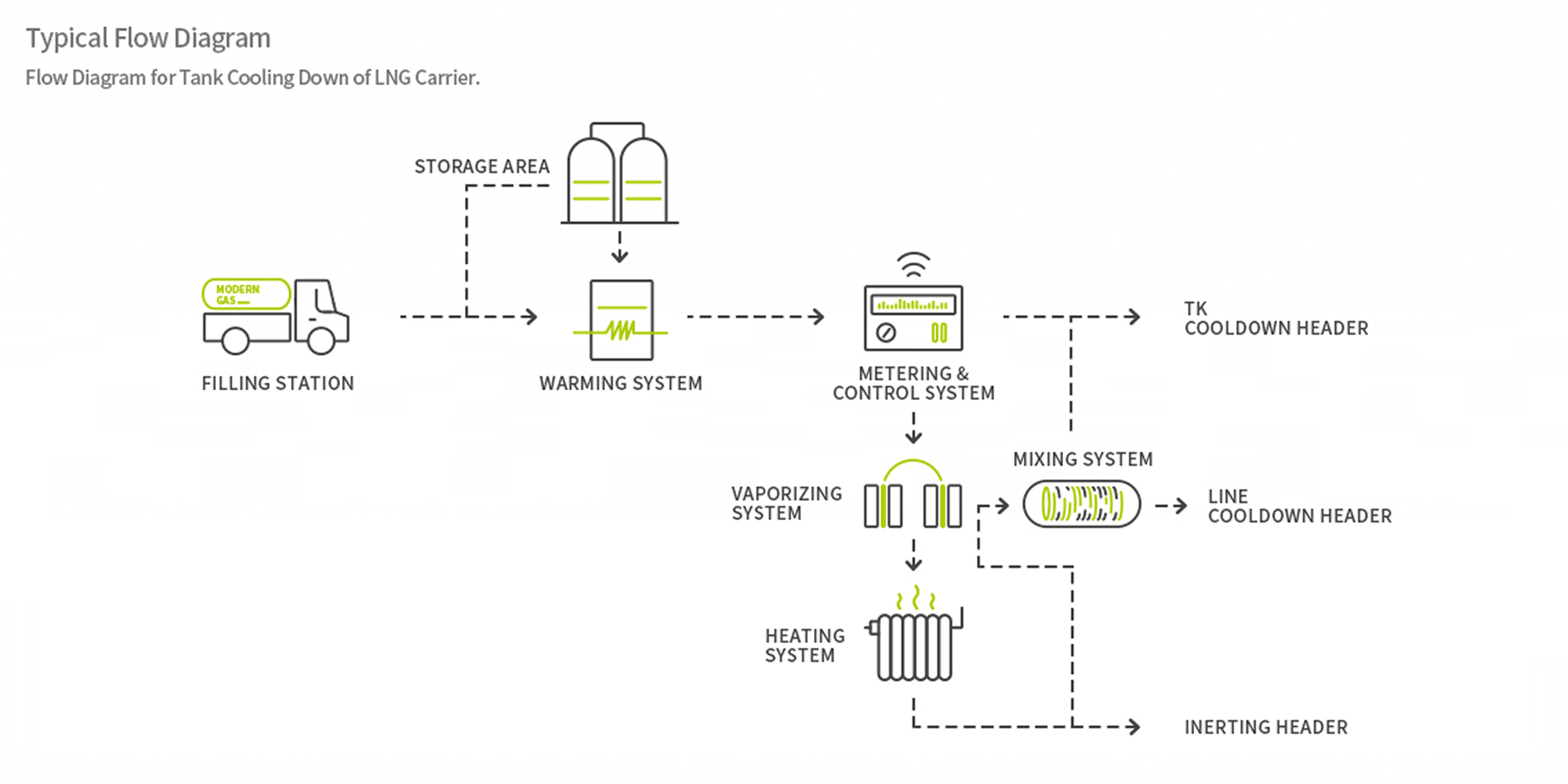
The boiling point of liquid nitrogen is -196°C, which is significantly lower than that of LNG at -166°C, so injecting it directly into a tank at such a low ultra-low temperature is very dangerous, as it can cause cracks in the LNG tank.
Therefore, during tank testing, the target object’s cooling performance was tested by warming up nitrogen to maintain a liquid state of -180°C or higher and injecting it into the tank. For line cooling, cooling tests were successfully conducted using equipment and construction methods that inject a -110°C liquid mixture in a mist state, and we possess the related operational know-how, equipment, and patents.
When testing a completed compressor, if the test is performed using ordinary air or nitrogen, the temperature rises, making it impossible to conduct a normal performance test.
Therefore, Modern Co., Ltd. utilizes the characteristics of Low Density Gas to provide a Mixing Flow System that supports low, medium, and high pressure tests.

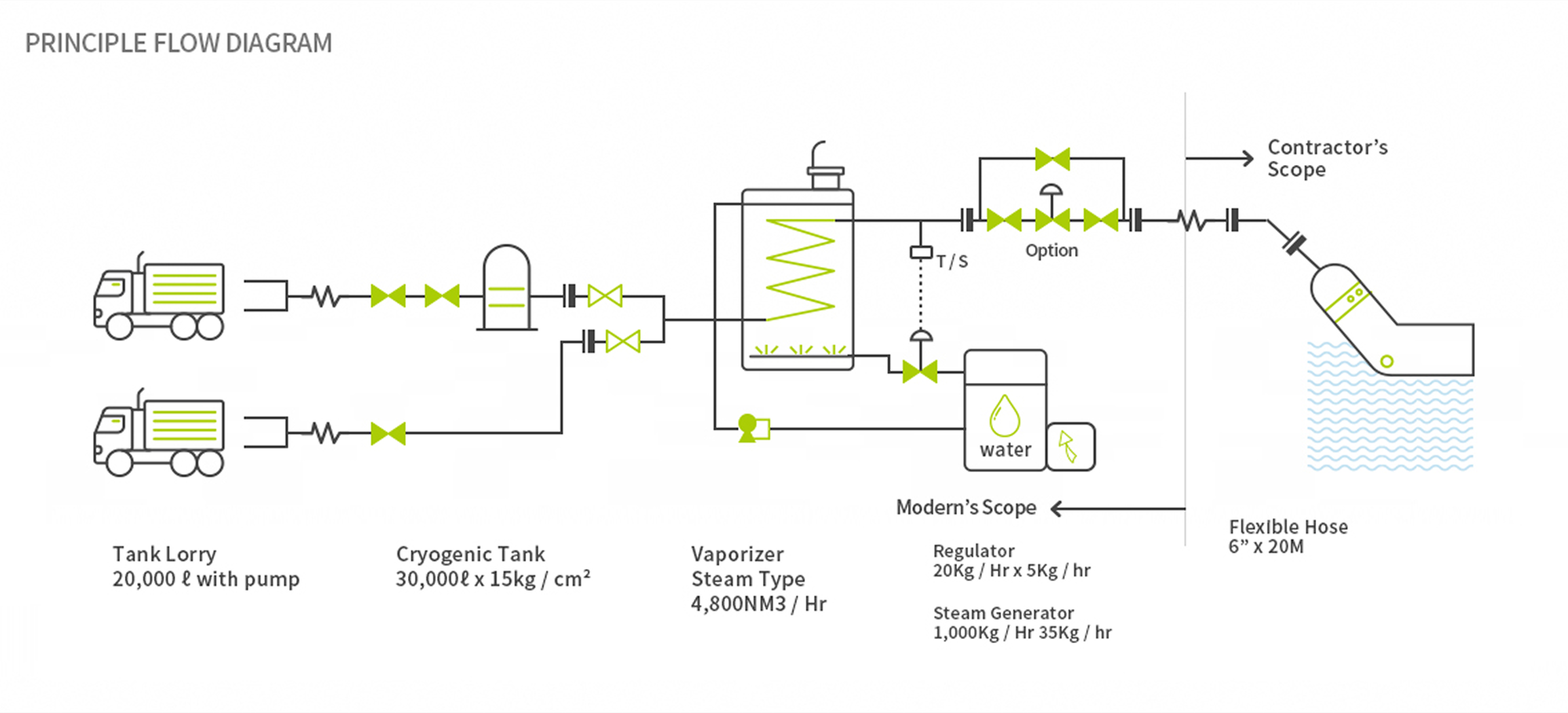
After the construction of the submarine pipeline, we are equipped with facilities for pressure testing and purging of the Offshore and Onshore Pipelines. These facilities are broadly classified into a Filling System capable of continuously supplying liquid nitrogen and a Vaporizing System for vaporizing it. The Vaporizer consists of a Steam Type vaporizer, a Steam Generator, and a Regulating Hook-up, and is capable of reaching a maximum capacity of 10,000 m³/Hr and a maximum temperature of 60°C (4,000 m³/Hr).